Monticello Downtown Business
Historic Commercial Renovation
111 S. State Street | Monticello, Illinois | 2009
In 2009, my wife and I undertook the renovation of a historic commercial building in downtown Monticello, Illinois, for our retail business, Village Wardrobe.
We worked with the local Main Street organization and historic architect, Kennedy Hutson, who developed drawings based on historical photographs of the building. We hired contractors to remove a 1970s-era storefront addition and reconstruct the façade to more closely reflect its original appearance.
The interior renovation included uncovering and restoring the original flooring, installing a faux-tin ceiling and updated lighting, remodeling the bathroom, and creating dressing rooms and storage areas.
The finished building provided a functional retail space while restoring much of the storefront's historic character.
Our involvement in downtown Monticello extended beyond our own business. While my wife served on the local Main Street board, I worked alongside her assist organizing several community events designed to bring people downtown and support local businesses. Several of those events continue today, more than a decade later.
This was one of two historic commercial properties in which we operated businesses. Both experiences gave me firsthand knowledge of the costs, challenges, and practical decisions involved in maintaining older downtown buildings. Just as importantly, I came to understand the tremendous amount of work, dedication, and personal investment that goes into running an independent downtown business.
We closed Village Wardrobe in 2015 to pursue other business ventures, but it remains a particularly meaningful chapter in our family's history. Four of our children grew up around the business, and we all enjoyed being part of the downtown community.
That experience has stayed with me throughout my municipal career. When I work with downtown property owners, business operators, and community organizations today, I understand their perspective not only as a City Manager, but as someone who has been on the other side of the counter.

Homer Downtown Business
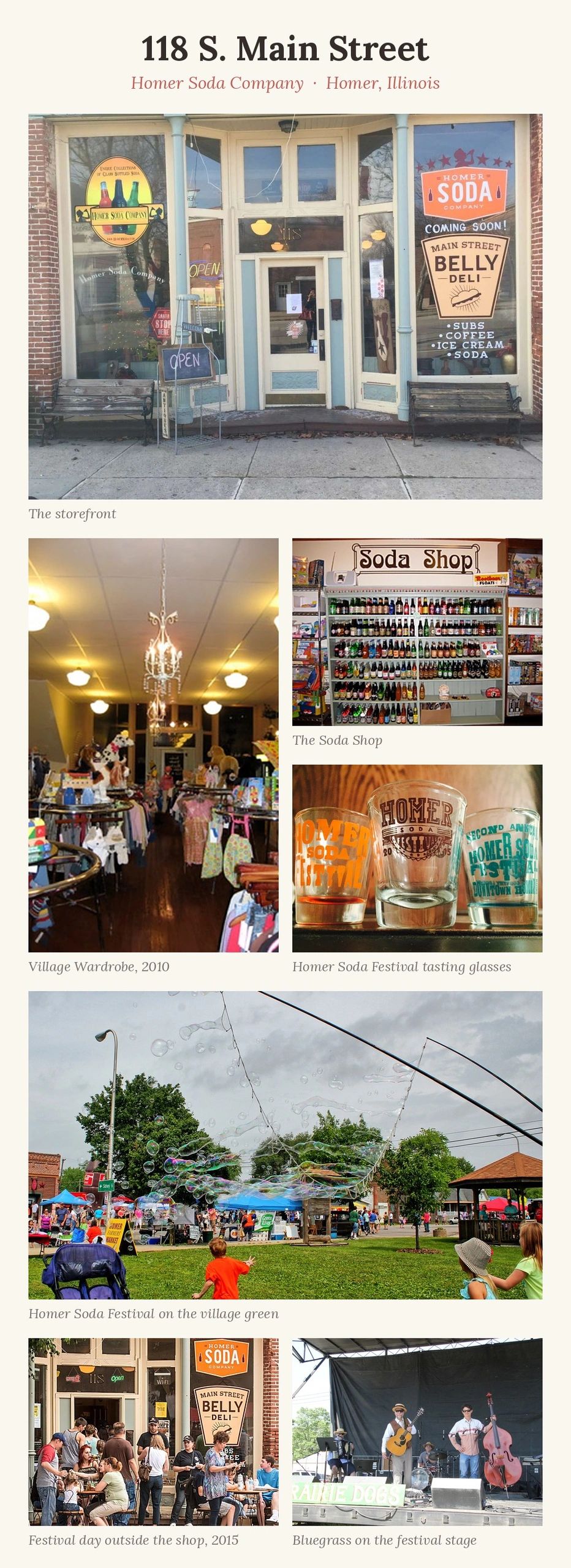
Homer Soda Company & Village Wardrobe
118 S. Main Street, Homer, Illinois
Homer Soda Company started in 2003 with one old soda machine. Ray and Christine Cunningham ran an antique shop on Homer’s historic Main Street. Ray traveled the country for work and brought home hard-to-find vintage sodas to stock the machine. Word spread, and people started driving to Homer just for the sodas.
When we heard the shop might close, we didn’t want our little town to lose it. In 2008, Kate took over the business and did everything she could to keep it going. She opened Village Wardrobe, a children’s consignment boutique, at 118 S. Main, with the Soda Shop inside. Customers came for kids’ clothes and toys and left with a bottle of Dang Butterscotch Root Beer or Nehi Grape. In 2009, we expanded Village Wardrobe to a second location on the square in Monticello, a town with more tourist traffic.
In 2011, we started selling wholesale, and the company grew well beyond Homer. In 2012 alone, sales grew 400 percent. We shipped to customers as far away as Texas, New Hampshire, and North Carolina, and sold starter kits to coffee shops and ice cream chains across the Midwest. The company was featured on ABC’s Good Morning America and in Country Living and Food Network Magazine. At its peak, we carried more than 250 glass-bottled sodas, almost all made with cane sugar.
In 2013, we launched the Homer Soda Festival. We planned for about 500 people, and 3,000 to 5,000 showed up. By 2015, the festival drew an estimated 10,000 visitors to a village of about 1,200, with 97 volunteers, a car show, a barbecue cook-off, and bluegrass on Main Street.
Watch the first Homer Soda Festival (2013): https://www.youtube.com/watch?v=8z6yHFyVD1Y
Kate led the business day to day. I played a guiding and supporting role while running a manufacturing plant and operating three municipal water utilities. I advised on the business, made deliveries, and made sales calls. On festival days, I ran operations, coordinating volunteers, vendors, and the logistics of bringing thousands of people into a small town for a day.
In 2015, the Main Street shop passed to new owners as Main Street Belly Deli, which kept vintage sodas on its shelves. We kept the wholesale business going until 2017. The lesson I took from Homer drives my work in public service: when one storefront comes alive, the whole downtown benefits.